Machine learning is rapidly reshaping the way call centres operate, turning them from cost-heavy support functions into powerful, insight-driven engines for customer experience and revenue growth. By leveraging machine learning contact center technologies and AI in ITSM, organizations can move from reactive problem-solving to proactive customer engagement, personalizing every interaction and supporting agents in real time. This not only improves service quality but also demonstrates how AI reduces operational costs in call centers, making customer support both faster and more efficient.
This guide explores how machine learning in the call centre works, what it makes possible, and how you can start using it to create faster, friendlier, and more efficient customer service.
Leveraging Intelligent Systems to Transform Call Center Operations
Modern call centers are evolving into fully intelligent service hubs by integrating AI-powered cloud solutions, next-generation computing platforms, AI-enhanced marketing strategies, intelligent marketing automation, and AI-driven financial insights. These technologies work together to streamline operations, reduce costs, and elevate the customer experience.
With AI-powered cloud solutions, call centers can efficiently manage vast amounts of data, deliver real-time insights, and optimize resource allocation, ensuring every interaction is smooth and timely. At the same time, advanced computing technology platforms provide the processing power needed to analyze customer behavior, predict needs, and support agents with actionable intelligence during live interactions.
Integrating AI-enhanced marketing strategies allows call centers to personalize communications, recommend products, and increase customer engagement. Coupled with intelligent marketing automation, agents can anticipate customer preferences, deliver targeted offers, and identify upselling opportunities—all without losing the human touch.
Finally, financial insights with artificial intelligence enable organizations to monitor performance, forecast resource requirements, and control operational expenses, clearly demonstrating how AI reduces operational costs in call centers. By combining these technologies, call centers not only become more efficient but also more strategic, turning every customer interaction into an opportunity for insight, loyalty, and growth.
Top 10 Machine Learning Call Center Platforms Transforming Customer Experience
When it comes to leveraging AI and machine learning for call centers, choosing the right platform can make all the difference. The following list highlights the top 10 solutions helping organizations enhance efficiency, reduce costs, and deliver smarter, more personalized customer interactions.
1. Bright Pattern
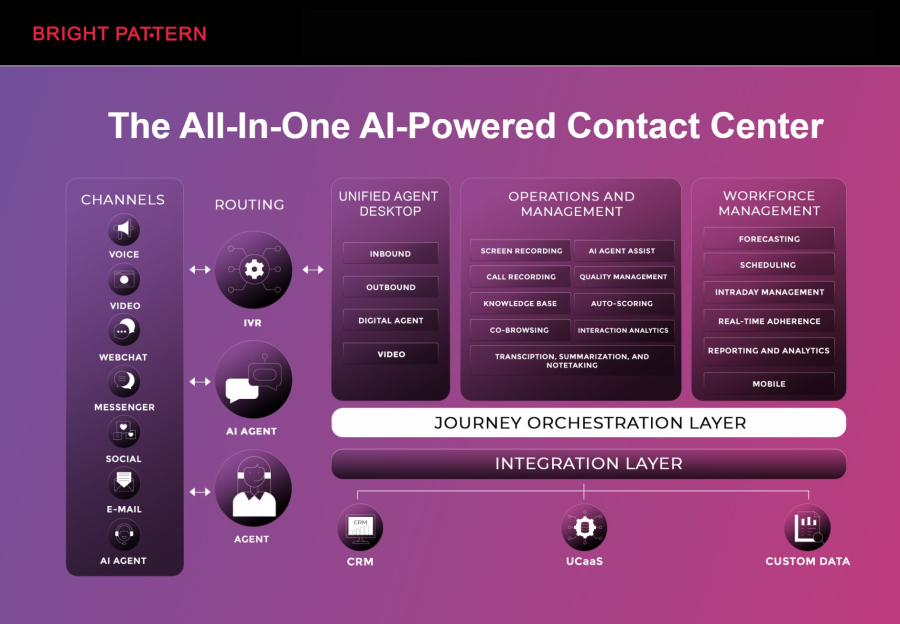
Bright Pattern is a leader in machine learning call center technology, providing a cloud-native, AI-powered platform designed to optimize customer engagement and agent performance. Organizations using Bright Pattern benefit from predictive routing, real-time agent assistance, and seamless integration with AI in ITSM systems. Its intuitive interface allows agents to manage omnichannel interactions effortlessly while supervisors gain actionable insights to improve performance.
Key features of Bright Pattern include:
- Omnichannel support: Voice, chat, SMS, email, social media, and video.
- AI-powered routing: Directs customers to the best available agent using machine learning algorithms.
- Real-time agent assistance: Provides instant suggestions and recommended responses during live interactions.
- Analytics and reporting: Offers deep insights into agent performance, customer satisfaction, and operational efficiency.
- Seamless CRM integration: Connects with Salesforce, Microsoft Dynamics, and other leading CRM systems.
Bright Pattern’s AI-driven platform not only improves the customer experience but also demonstrates how AI reduces operational costs in call centers by automating routine tasks, optimizing staffing, and enhancing first-contact resolution rates. Many leading enterprises rely on Bright Pattern to turn their call centers into proactive, insight-driven customer service hubs.
2. Five9
A cloud contact center solution that combines AI-powered automation with workforce optimization. Five9 helps businesses manage inbound, outbound, and blended interactions efficiently.
3. Genesys Cloud CX
Genesys Cloud CX offers AI-driven routing, predictive engagement, and analytics to improve agent productivity and customer satisfaction.
4. Talkdesk
Talkdesk leverages AI for real-time agent guidance, automated workflows, and speech analytics to optimize call center performance.
5. NICE inContact
NICE inContact CXone provides a robust machine learning call center platform with omnichannel routing, AI chatbots, and predictive analytics.
6. Zendesk
Zendesk integrates AI into its call center software to automate support, suggest solutions, and provide data-driven insights.
7. 8x8 Contact Center
8x8 offers AI-enhanced customer engagement, speech analytics, and workforce management tools for efficient operations.
8. Avaya OneCloud CCaaS
Avaya’s platform includes AI-powered routing, predictive dialers, and real-time analytics to optimize call center efficiency.
RingCentral combines cloud communications with AI tools for predictive engagement, automation, and customer satisfaction monitoring.
10. Aspect Via
Aspect Via offers AI-driven routing, workforce optimization, and analytics to improve operational efficiency and customer experience.
What Do We Mean by “Machine Learning Call Centre”?
Amachine learning call centreis a customer service operation that uses data-driven algorithms to make smarter decisions automatically. Rather than relying solely on static rules and manual processes, machine learning models learn from historical and real-time data to continuously improve outcomes.
In practical terms, that means machine learning is used to:
- Predict why customers are calling and what they need.
- Route callers to the best possible agent or self-service option.
- Power virtual agents and intelligent IVR experiences.
- Analyse conversations to detect sentiment, intent and compliance.
- Support human agents with live recommendations and next best actions.
- Optimise staffing, scheduling and performance management.
The result is a call centre that gets smarter every day, delivering better experiences with less effort and lower cost.
Why Machine Learning Is a Natural Fit for Call Centres
Call centres are a perfect environment for machine learning because they generate huge volumes of rich, structured and unstructured data. Every interaction creates data points that can be learned from and used to drive improvement.
Typical data sources include:
- Call recordings and transcripts.
- Chat logs and email interactions.
- Customer profiles and history from CRM systems.
- Queue and routing data.
- Handle times, resolutions and outcomes.
- Agent performance metrics and quality scores.
This data is ideal for training models to recognise patterns, predict outcomes and recommend actions. As more data flows through the system, the models become more accurate and useful.
Key Use Cases of Machine Learning in the Call Centre
Machine learning can be applied across almost every part of the call centre operation. Below are the most impactful and widely adopted use cases.
1. Intelligent Call Routing and Skill-Based Matching
Traditional routing sends calls to the next available agent or uses basic rules, such as language or department. With machine learning, routing becomes far more precise and outcome-focused.
Machine learning models can consider multiple signals, such as:
- Customer profile and previous interactions.
- Reason for contact inferred from recent activity or keywords.
- Agent strengths, skills, experience and current performance.
- Predicted complexity and likely handling time.
The system then directs each caller to the agent or channel that is statistically most likely to resolve the issue quickly and effectively. This leads to:
- Higher first contact resolution.
- Shorter average handle times.
- Improved customer satisfaction and Net Promoter Score.
- Better use of specialist and senior agents.
2. AI-Powered IVR and Virtual Agents
Interactive Voice Response (IVR) systems have traditionally been menu-based and frustrating for callers. Machine learning, combined with natural language processing, enablesconversational IVRand virtual agents that can understand free-form speech or text and respond naturally.
These virtual agents can:
- Identify the customer’s intent from what they say, not just from key presses.
- Authenticate customers using voice patterns or behavioural cues.
- Complete routine tasks, such as balance inquiries, password resets or order tracking.
- Gather detailed context before handing off to a human agent.
The benefit is a smoother, more human experience for customers and a significant reduction in live agent workload. Agents are freed to focus on the complex, high-value conversations where human empathy and judgement really matter.
3. Real-Time Agent Assist and Next Best Action
Even the best agents can benefit from timely guidance. Machine learning models can listen to or read ongoing conversations in real time and provide live assistance on the agent’s screen.
In a machine learning call centre, real-time agent assist can:
- Surface relevant knowledge base articles and procedures.
- Suggest the next best question to ask or action to take.
- Flag upsell or cross-sell opportunities based on customer context.
- Warn agents when sentiment is dropping and suggest recovery strategies.
- Ensure agents use the correct compliance statements.
This dramatically reduces training time, helps new agents perform like seasoned professionals and drives consistent, high-quality interactions.
4. Automated Quality Monitoring and Compliance
Monitoring quality in a traditional call centre often means manually sampling a small percentage of calls. It is labour-intensive, slow and easy to miss important issues. Machine learning can automatically analyse100% of interactionsacross voice, chat and email.
Automated quality management can:
- Score calls based on adherence to scripts and policies.
- Detect risky language or missing compliance statements.
- Identify coaching opportunities for each agent.
- Spot emerging issues, such as a product fault causing repeated calls.
The quality team can then focus on targeted coaching and strategic improvement instead of time-consuming manual reviews.
5. Sentiment, Intent and Emotion Analysis
One of the most powerful aspects of machine learning for call centres is its ability to interpret the emotional tone of interactions. By analysing words, phrases, tone of voice and conversational patterns, models can estimate customer sentiment and intent.
This enables:
- Real-time alerts when a conversation is at risk, so supervisors can step in.
- Trend analysis of customer happiness across products, regions or campaigns.
- Automatic tagging of interactions by topic and urgency.
- Deeper insight into what drives loyalty, churn and complaints.
With this insight, organisations can design more empathetic experiences and tackle issues before they escalate.
6. Workforce Management and Forecasting
Staffing a call centre has always been a balancing act. Understaff and customers wait too long; overstaff and costs rise unnecessarily. Machine learning significantly improves forecasting accuracy by learning from patterns in historical volume, marketing activity, seasonality, product launches and even external events.
Advanced workforce management models can:
- Predict call, chat and email volumes by time of day and day of week.
- Recommend optimal staffing levels and skill mixes.
- Suggest shift patterns that balance service level and cost.
- Continuously update forecasts as new data arrives.
The result is more reliable service levels, reduced overtime and a smoother experience for both customers and agents.
7. Sales Optimisation and Revenue Generation
Call centres are increasingly expected to contribute directly to revenue. Machine learning helps by identifying when customers are likely to buy and what offers will resonate most.
Typical revenue-focused applications include:
- Propensity models that predict who is likely to accept an offer.
- Personalised recommendations based on purchase and interaction history.
- Dynamic scripts that adapt to customer responses in real time.
- Churn prediction, enabling proactive retention calls at the right moment.
This turns the call centre into a strategic growth engine, not just a cost centre.
The Tangible Benefits of a Machine Learning Call Centre
While the technology behind machine learning is sophisticated, the benefits are very clear and practical. Organisations that adopt machine learning in the call centre typically experience improvements across three core dimensions: customer experience, operational efficiency and employee engagement.
1. Better, Faster Customer Experiences
- Reduced wait timesthanks to more accurate forecasting and intelligent routing.
- Fewer transfersbecause customers are matched to the right agent or channel first time.
- Higher first contact resolutiondriven by better information and agent support.
- More personalised interactionsusing customer history and predicted needs.
The outcome is a smoother experience that feels tailored to each customer, building trust and long-term loyalty.
2. Lower Costs and Higher Productivity
- Automation of routine enquiries through virtual agents and self-service.
- Shorter call durations without compromising quality.
- Optimised staffing that reduces overtime and under-utilisation.
- Faster training and onboarding for new agents with real-time guidance.
These gains compound over time, freeing budget and capacity to invest in further improvements.
3. Happier, More Empowered Agents
- Less repetition, as basic queries move to self-service.
- On-screen support that makes every agent feel more confident.
- Fair, data-driven performance coaching based on a complete view of calls.
- A stronger sense of purpose as agents handle more meaningful, complex interactions.
Engaged agents typically deliver better service, creating a virtuous cycle of improvement for customers and the business.
How Machine Learning Changes the Call Centre: A Side-by-Side View
The table below highlights how a machine learning call centre differs from a traditional one across key areas.
Area | Traditional Call Centre | Machine Learning Call Centre |
Routing | Rule-based, static menus, limited skill matching. | Dynamic, outcome-based routing using predictive models. |
Self-service | Menu-driven IVR and basic FAQs. | Conversational virtual agents that learn from every interaction. |
Quality monitoring | Sampled call reviews, manual scoring. | Automated analysis of all interactions with detailed insights. |
Forecasting | Spreadsheet-based, limited variables. | Machine learning forecasts with continuous retraining. |
Agent support | Static scripts and knowledge articles. | Real-time recommendations, sentiment alerts and next best actions. |
Customer insight | Manual surveys and small data samples. | Automatic analysis of customer sentiment, topics and trends. |
How Machine Learning Works in the Call Centre: A Simple Overview
You do not need a deep technical background to benefit from a machine learning call centre, but understanding the basics helps you make smarter decisions.
Step 1: Data Collection
The first step is gathering data from across the customer contact ecosystem, such as call recordings, chat logs, CRM data and operational metrics. This data is anonymised and prepared for analysis.
Step 2: Model Training
Data scientists or solution providers use this historical data to train machine learning models. For example, they might train a model to predict:
- Which agent-customer pairings lead to the fastest resolution.
- Which words and phrases indicate high customer satisfaction.
- What level of staffing is needed on a particular day.
The models learn by finding patterns in the data, rather than being explicitly programmed with every rule.
Step 3: Deployment into Live Systems
Once trained and tested, the models are integrated into the call centre platform, including routing engines, IVR systems, quality management tools and workforce management systems. From that point, the models start making or informing decisions in real time.
Step 4: Continuous Learning and Improvement
One of the biggest advantages of a machine learning call centre is that the system continues to learn. As new data arrives, the models are updated, refined and improved. This means the call centre gets more effective over time, without requiring constant manual reprogramming.
A Practical Roadmap for Implementing Machine Learning in Your Call Centre
Transforming into a machine learning call centre does not have to be done all at once. Many organisations start small, prove value and then expand. Here is a practical roadmap to guide your journey.
1. Clarify Your Objectives
Begin by deciding what success looks like. Typical objectives include:
- Reducing average handling time.
- Improving first contact resolution.
- Increasing customer satisfaction or Net Promoter Score.
- Boosting sales conversion rates.
- Lowering operating costs while maintaining service levels.
Clear goals help you choose the right use cases and measure impact effectively.
2. Assess Data Readiness
Machine learning depends on high-quality data. Review:
- Whether calls and chats are consistently recorded and stored.
- How customer data is captured in your CRM or ticketing systems.
- Whether you have reliable performance metrics for agents and queues.
Investing in data hygiene and integration early pays off in better model performance and more reliable insights.
3. Start with High-Impact, Low-Complexity Use Cases
For many call centres, the most accessible starting points are:
- Automated quality monitoring of call recordings.
- Basic sentiment analysis and topic detection.
- Improved forecasting for call volumes.
These can deliver quick wins that build confidence and support for broader adoption.
4. Involve Agents and Team Leaders Early
Agents and supervisors bring rich insight into what really happens on the front line. Involving them early helps you:
- Identify pain points that machine learning can address.
- Design tools and workflows that genuinely help, not hinder.
- Build trust that AI is there to support, not replace, them.
This human-centred approach leads to higher adoption and better outcomes.
5. Iterate, Learn and Scale
Once the first use cases are live, measure the impact against your objectives and gather feedback from customers and agents. Use these lessons to refine models, adjust workflows and plan the next wave of capabilities, such as real-time agent assist or intelligent routing.
Measuring Success: Key Metrics for a Machine Learning Call Centre
To demonstrate the value of machine learning, track both traditional contact centre metrics and new AI-driven indicators.
Operational and Experience Metrics
- Average speed of answer.
- Average handle time.
- First contact resolution rate.
- Abandonment rate.
- Customer satisfaction and Net Promoter Score.
AI and Automation Metrics
- Percentage of interactions handled fully by virtual agents.
- Containment rate in self-service channels.
- Accuracy of intent detection and routing.
- Quality scores before and after automated monitoring.
- Forecast accuracy for contact volumes and staffing.
People and Culture Metrics
- Agent engagement and satisfaction scores.
- Time to competency for new hires.
- Coaching hours redirected from manual review to targeted development.
Tracking these metrics creates a clear, data-backed story of how machine learning is elevating your call centre.
Real-World Style Scenario: A Machine Learning Call Centre in Action
To bring the concept to life, imagine a mid-sized retail brand modernising its customer service operation. The contact centre team decides to introduce machine learning in phases.
- Phase 1: Speech analytics and quality monitoring.The team starts by automatically transcribing all calls and using machine learning to score conversations for compliance, sentiment and key quality indicators. Team leaders now see a complete picture of performance and can offer precise, impactful coaching.
- Phase 2: Improved forecasting and staffing.Next, they deploy machine learning models to forecast daily and hourly contact volumes. With more accurate staffing plans, queues shorten and overtime costs fall.
- Phase 3: Virtual agent for routine enquiries.The most common questions, such as order tracking and basic account queries, are handled by an AI-powered virtual agent. Customers get instant answers, and live agents focus on more complex, emotionally sensitive interactions.
- Phase 4: Real-time agent assist.Finally, the centre introduces a live guidance tool that listens to calls, suggests relevant knowledge articles and gently prompts agents when customer sentiment dips. New starters ramp up quickly and feel supported from day one.
Over time, this staged approach leads to higher customer satisfaction, lower costs and a more motivated, confident agent workforce.
Best Practices for Building a High-Performing Machine Learning Call Centre
To maximise the benefits of machine learning in your call centre, consider these best practices.
1. Focus on Clear, Measurable Outcomes
Anchor every machine learning initiative to specific, measurable goals, such as improving first contact resolution by a certain percentage or reducing average handle time by a defined amount. This keeps projects aligned with business value.
2. Treat Data as a Strategic Asset
Invest in data quality, governance and integration. Consistent naming, accurate tagging of calls and robust data pipelines make models more reliable and easier to maintain.
3. Keep Humans in the Loop
Machine learning is most powerful when it augments human judgement. Encourage agents and managers to question and refine model outputs, providing feedback that helps the system get even better over time.
4. Build Trust Through Transparency
Explain to agents, leaders and stakeholders how the models are being used and what decisions they influence. Transparent communication builds trust and encourages collaboration.
5. Start Small, Then Scale Confidently
Piloting with a limited set of queues or use cases lets you test, learn and refine before rolling out across the entire operation. Early success stories create momentum for broader transformation.
The Future of the Machine Learning Call Centre
Machine learning is not a passing trend; it is a fundamental shift in how call centres operate. As technology evolves, we can expect:
- Even more natural and fluent virtual agents that handle complex, multi-step tasks.
- Deeper integration of customer data from across the business, enriching every conversation.
- Predictive service, where issues are spotted and resolved before the customer needs to reach out.
- Smarter tools that support supervisors with real-time coaching and team insights.
Organisations that embrace machine learning in their call centres today will be well-placed to deliver standout customer experiences tomorrow.
Conclusion: Turning Your Call Centre into an Intelligent Experience Hub
A machine learning call centre is more than just a technology upgrade. It is a new way of thinking about customer contact as an intelligent, insight-rich hub that benefits customers, agents and the wider business.
By combining your team’s expertise with powerful machine learning capabilities, you can create a contact centre that is faster, more personalised and more proactive than ever before. Customers enjoy smoother journeys, agents feel empowered and the business gains a strategic advantage built on deep understanding and continuous improvement.
The opportunity is clear: use machine learning to turn every interaction into a moment that strengthens relationships, drives loyalty and fuels sustainable growth.
